
en

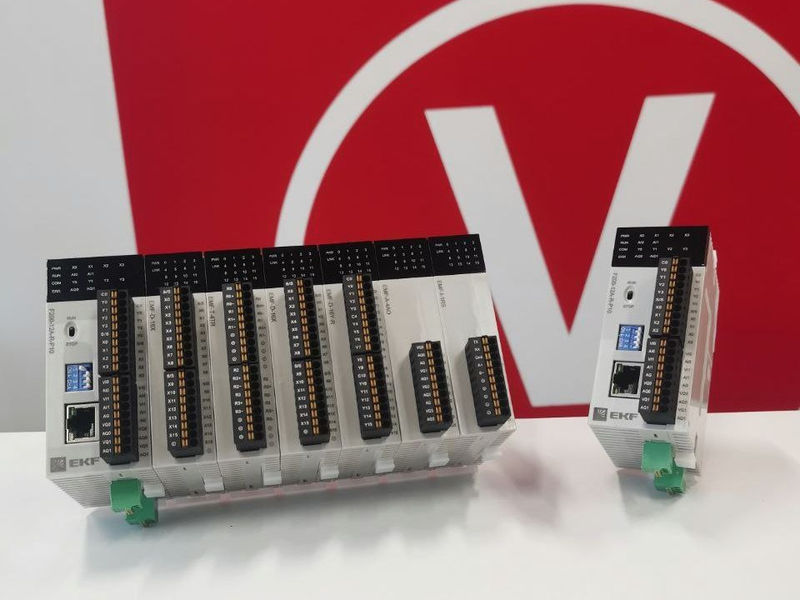
PRO-Logic function
PLC PRO-Logic is designed to build systems for monitoring and automating control of various technological systems: lighting, ventilation, heating, water supply, water treatment, conveyors, packing belts, etc.
PRO-Logic main data
24 V DC power supply
input/output signals: discrete and analog
types of output signals: 2 A e/m relays or NPN transistors
interfaces: RS-485 and Ethernet
PRO-Logic controller features:
1. Reliable and convenient mounting
Removable spring-type terminals
Simple connection
Time saving
Reliable connection
Vibration resistance
No broaching required
2. Integration into monitoring and control systems
Integrated standard interfaces for connection to peripheral devices (sensors, frequency converters, operator’s panels) and control systems (OPC, SCADA )
Ethernet (protocol Modbus TCP)
RS-485 (protocols Modbus RTU, Modbus ASCII)
3. Scalability
Increase in the number of input/output points to 256!
Extension modules:
Discrete modules
Analogue modules
Temperature modules (thermocouples, thermal resistance)
Interface modules (RS-232/485)
4. Indication of system status
Visual control:
Input and output status
Device status
Available errors
Communication with peripheral devices
5. Saving space
Compact size and DIN rail mounting
6. High-speed computation and control
High speed inputs and outputs 200 kHz
7. Connection of temperature sensors
Thermal resistances: Pt100, Pt1000, Cu50, Cu100
Thermocouples: S, K, E, J, B, N, R, Wre3/25, Wre5/26
8. Easy configuration and programming
PRO-Logic master: free project development environment.
Standard programming languages: FBD, LD, IL.
Integrated library with support for 188 functions.
Built-in simulator for system debugging.
PRO-Logic application areas
Heating, ventilation, air conditioning.
Metal processing.
Woodworking.
Water treatment, water supply.
Food processing industry.
Conveyors, packaging, bottling.
Benefits of using PRO-Logic controllers:
Process optimization and operating cost reduction
Equipment condition monitoring and predictive review
Stability and safety of system operation